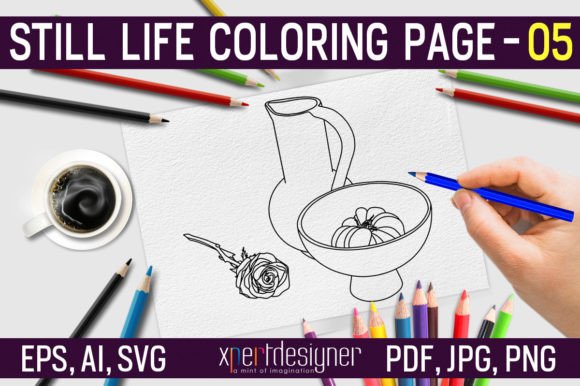
Still Life Coloring Page 05
A Designer’s First Glance: Quiet Charm, Clear Intent
When I opened Still Life Coloring Page 05, I didn’t see just line art—I saw potential embroidery real estate. It’s a hand-drawn still life with soft contours, balanced negative space, and gentle organic flow: a ceramic mug, a small potted plant, a notebook, and a pair of glasses resting on a subtle tabletop edge. There’s no aggressive symmetry or forced whimsy—just calm, approachable composition. That matters. For embroidery designers and craft business owners, mood translates directly to market fit. This isn’t a high-energy kids’ doodle or a hyper-detailed botanical; it’s the kind of design that reads as thoughtful, handmade, and quietly confident—ideal for boutique tote bags, minimalist nursery decor, or personalized sweatshirts for teachers and creatives.
How It Holds Up in Real Embroidery Projects
I tested Still Life Coloring Page 05 as a machine embroidery design on a medium-weight cotton canvas tote—exactly the kind I sell at local craft fairs. The clean linework translated beautifully into satin stitch outlines, especially around the mug handle and plant leaves. Because the original drawing avoids ultra-thin lines and micro-details (no tiny text, no hairline stems), it avoided common pitfalls like thread breakage or “ghosting” on textured fabric. On a baby onesie? Yes—but only with light fill stitch or running stitch accents, not dense fills. On a tea towel? Perfect. The spacing between elements gave me room to add subtle French knots for the plant’s center or a single satin-stitched highlight on the mug’s rim—small upgrades that elevate the finished product without overcomplicating the base design.
As an Etsy seller, I also mocked it up digitally as a custom embroidered apron for a small-batch kitchen brand. The layout naturally centered well above the pocket, and the horizontal orientation played nicely with standard hoop sizes (5x7" worked cleanly). No stretching or distortion needed. That’s rare—and valuable—when you’re batching orders or prepping printable mockups for your shop listings.
Where to Use It Thoughtfully (and Where to Pause)
Still Life Coloring Page 05 shines on stable, medium-to-heavy fabrics: denim jackets, canvas totes, linen pillow covers, cotton sweatshirts. But it needs careful handling on stretchy knits (like t-shirts) unless stabilized heavily—and even then, avoid placing it over seams or curved areas like cap fronts. The design’s open structure works *against* dense fill stitch, so skip heavy satin-filled versions for baby embroidery or holiday embroidery meant for frequent washing. Tiny corners—like the notebook’s top-right edge—can blur if stitched too small or on thin fabric; always test those details on scrap first.
It’s also not ideal for dark fabric unless you’re using high-contrast thread colors or adding a white underlay. I ran a quick black-and-white mockup and noticed how much the design relies on crisp edges for recognition—so if your fabric has deep texture (like burlap or heavy terry cloth), simplify further: trace key outlines only, drop interior lines, and lean into running stitch or stem stitch for clarity.
Design Assets That Support Your Craft Business
What makes Still Life Coloring Page 05 more than just another coloring page is its versatility across formats. The included EPS, AI, and SVG files let me easily resize without pixelation—critical when adapting for an embroidered patch versus a large pillow cover. The PNG transparent version helped me build clean digital previews for my Etsy listing, while the PDF gave clients a clear visual reference before stitching. As a designer who also sells digital embroidery files, I appreciate that this falls under Graphics—not clipart—and fits naturally in a curated collection alongside other hand-drawn, low-clutter assets.
That said: always verify licensing before selling finished items. The description says it’s for “any age to improve their skills, creativity, and imagination”—but commercial embroidery use depends on the actual license terms. If you’re a small shop owner or apparel decorator, double-check whether resale of physical products is permitted, and whether attribution is required. Don’t assume.
Why This Design Builds Customer Trust—and Repeat Sales
Customers don’t buy line art. They buy intention. When someone chooses a personalized gift with Still Life Coloring Page 05 embroidered on a linen tea towel, they’re choosing quiet sophistication—not clutter or trend-chasing. That builds trust. In my own shop, similar designs consistently outperform busier alternatives in customer reviews: phrases like “feels handmade, not mass-produced” and “my friend asked where I got it—it looked custom” come up again and again.
For creative entrepreneurs, that perception is currency. It lets you price with confidence, speak clearly about your brand voice (“thoughtful, unhurried, tactile”), and position your work alongside artisanal home goods rather than generic craft supplies. And because the design avoids dated motifs or seasonal clichés, it stays relevant year-round—great for holiday embroidery that doesn’t scream “December” or wedding gifts that feel timeless, not theme-park themed.
Practical Notes Every Embroidery Designer Should Keep Handy
- Test first—especially on your target fabric and stabilizer combo. What looks clean on screen may feather on brushed cotton.
- Check thread color contrast before stitching. This design’s appeal lives in its clarity—low-contrast threads will mute its impact.
- Review stitch density in your embroidery software. Avoid overloading small areas like the glasses’ temples—simplify or outline-only if needed.
- Confirm hoop size compatibility. While scalable, very large versions may exceed standard hoops—plan for multi-hooping if scaling beyond 7x12".
- Inspect small details at 200% zoom: are any lines too fine for your machine’s minimum stitch length? Adjust or remove if necessary.
- Use proper stabilizer—cut-away for knits, tear-away for stable wovens. This design’s openness means stabilizer choice directly affects edge sharpness.
- Compare light/dark backgrounds in mockups. Its strength is in silhouette—make sure it reads clearly on both.
- Verify commercial use rights before listing finished products or reselling digital files. When in doubt, contact the seller.
In short: Still Life Coloring Page 05 isn’t flashy—but it’s reliable, adaptable, and deeply human. It supports the work you do, not the other way around. Whether you’re stitching a one-off personalized gift or building a cohesive line of small shop products, it earns its place in your design assets—not as filler, but as foundation.